Sell a damaged car in Milwaukee for cash
Rusted through, hail-dented, wrecked, or stripped for parts — a VIN is all we need to price it.
- ✓Every damage type quoted01
- ✓Runs or not, keys or not02
- ✓Paid the moment it's loaded03
7 AM – 9 PM
The damage changes the number,
it doesn't erase it
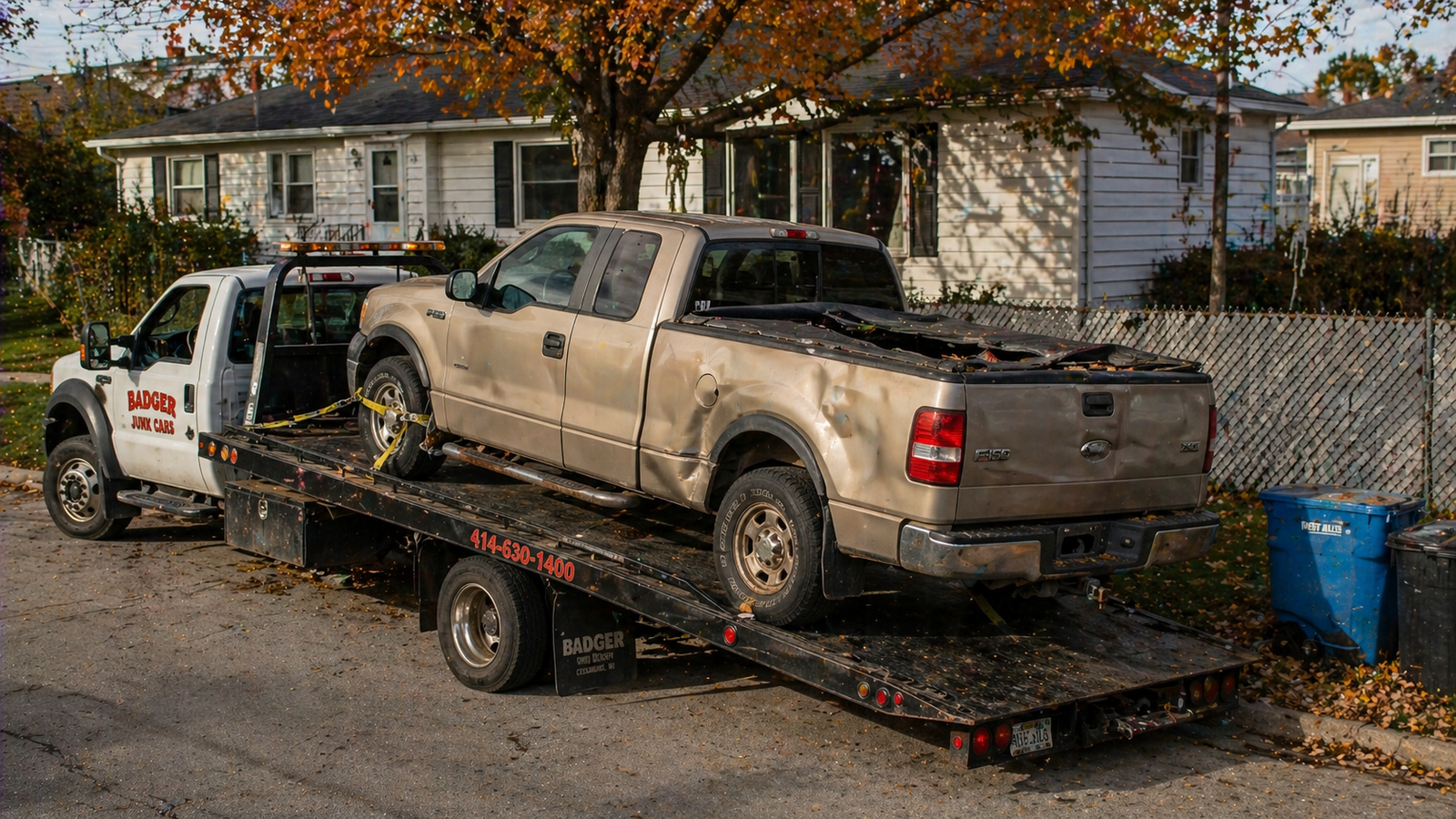
Rust, hail, collision, flood, missing parts — selling a rusted or dented car here is deliberately boring: tell us the year, make, model, and what's wrong, and you get a typical, estimated offer without hauling the car anywhere.
Dented sheet metal barely moves what a salvage buyer actually pays, because the drivetrain and parts underneath are what carry the value.
Below: exactly which damage we buy, how each kind moves the number, and how to line up a pickup — plus the two situations sellers assume are dealbreakers (missing parts, missing title) and why neither one is.
Where we pick up damaged cars
across metro Milwaukee
Everywhere within reach of our Walker's Point yard, out to roughly 40 miles — tow always included.
Red chips have their own pickup page · plain chips are covered identically
Milwaukee proper, inner suburbs like West Allis, Wauwatosa, and Greenfield, out through Oak Creek, Brookfield, New Berlin, and Waukesha, and down the lakeshore to Racine and Kenosha.
Flat tires, dead battery, no keys, sunk to the axles in a back yard since last winter — the flatbed handles all of it. Because we run our own trucks, most cars are collected the day you accept an estimate, and the tow never comes out of your payout — a mile from the yard or forty.
You don't bring the car to us, and it doesn't need to move under its own power. On the edge of the metro? Give us the location and we'll confirm coverage before you commit to anything.
Cars missing engines, converters,
or wheels still pay
Most of what a junk car buyer pays for is the vehicle, not one component. Tell us what's gone and what's left so the estimate lands right the first time.
M.1
Engine already out
With the motor gone, the body, frame, transmission, and remaining drivetrain still price by weight — curb weight is one of the biggest inputs in the whole quote.
M.2
Converter cut off
The catalytic converter is the big one: intact, it's roughly 15 to 40 percent of a vehicle's value on its own. A car that's had its cat stolen quotes lower than the same car with it bolted on — lower, not zero.
M.3
Wheels, battery, small parts
Missing wheels, battery, alternator, or starter each subtract their own share, since those are parts that would otherwise add to the number.
M.4
The salvage floor
Even stripped to a rolling shell, the metal has weight and the weight has a price. That floor is why we quote cars other buyers wave off — a picked-over car with its steel intact is a long way from worthless.
The damaged cars we buy,
and why they still pay
A damaged car is valued as salvage, on its metal and usable parts, not on whether it looks presentable. The pattern is consistent: damage that ends a car's road life rarely ends its salvage value.
D.1
Rust-through
Rotted rockers, floors, and frame rails are structural, so repair rarely makes sense — but the sound steel that's left still weighs and still pays.
D.2
Hail damage
Dented panels are cosmetic. They barely shift a salvage offer, because everything underneath them is untouched.
D.3
Flood & water damage
The electronics may be dead, but the engine core, transmission, wheels, and converter are still recoverable.
D.4
Missing parts
Every absent part subtracts its own share — the grid above breaks down exactly how much each one moves the quote.
D.5
High mileage
Miles gut resale value but hardly touch salvage value. A 250,000-mile car weighs the same as a 40,000-mile one.
Why Milwaukee winters rot cars
(rust still pays)
Milwaukee eats cars from the underside up. Every winter, road salt and brine coat the streets, and the lake-effect wet-cold cycle keeps that salt working against bare metal for months. Over a few Wisconsin winters it chews through rocker panels, brake and fuel lines, floor pans, and eventually the frame — the parts you don't see until something gives out.
We see the same story constantly: a car that still starts and drives but is rotting structurally. Once the frame or subframe is compromised, the car fails inspection and isn't safe or economical to repair, no matter how well the engine runs. A rusty runner has crossed into junk value even though it still moves.
The rust-and-all number still comes from real material — the sound steel and aluminum left in the body and drivetrain, plus every intact part that survived the salt. A rotted title, or none at all, isn't a dealbreaker either.
How selling your damaged car
works — quote, pickup, cash
The quote
Give us the year, make, model, and a quick rundown — what's damaged, what runs, what's missing. If the car has a VIN, that's usually all we need to put a real, estimated number on it. No walk-around, no photos required.
The pickup
Accept the estimate and we schedule a same-day tow anywhere in the metro. You don't fix anything, wash anything, or drive anywhere — the truck comes to the driveway, the garage, or the back of the lot where the car sits.
The cash
You're paid on the spot as the car is loaded. Have your ID ready, plus the title if you have one — and if you don't, selling without a title is a routine path, not an exception.
Hail-totaled and stripped cars:
what they're worth
An insurance company can total a car on hail while a salvage buyer still sees a valuable vehicle. Dents in the roof, hood, and panels never reach the engine, transmission, converter, and wheels underneath — and those are what drive the offer. Every damaged-car quote reduces to the same four inputs, in roughly this order of weight.
In order of weight
Year, make, and model
What the vehicle is, which sets demand for its parts.
Then
Curb weight
The recoverable steel and aluminum the car carries.
Then
Completeness
The converter above all, then wheels, battery, alternator, starter.
Finally
The day's scrap index
Live pricing for steel, aluminum, and copper.
Damaged-car questions
we hear from sellers
Something specific to your car? The full archive goes deeper, or ask on the call — the quote and the answers come from the same person.
Every question we get, in one place →Yes to all three. Damage type doesn't disqualify a car — it's priced as salvage on the metal and the parts that survived. Non-running, wrecked, and flooded cars are ordinary here, loaded on our own flatbed.
Usually, yes — it's a routine path, not an exception. Wisconsin normally completes a sale on the title, and a registered owner whose copy is missing can request a replacement. Flag it on the first call and we'll tell you what your vehicle needs.
Typically $200 to $2,500 depending on the vehicle, what's intact, and the day's metal market — an estimate, not a guarantee. Cosmetic damage like hail barely moves it; missing parts like the converter move it more.
No — the tow is free at every address in range and never deducted from the offer, whether the car is a mile from the yard or forty.
Yes. A missing engine still leaves the body, frame, transmission, and drivetrain to price by weight; a missing converter lowers the number but doesn't zero it. Tell us what's gone so the estimate lands right.
Milwaukee County and the surrounding Southeast Wisconsin metro — roughly a 40-mile radius from the Walker's Point yard, out through the inner suburbs to Waukesha, Oak Creek, and down the lakeshore to Racine and Kenosha.
Every other sale we
handle across the metro
One call settles it
Get your cash offer for a
damaged car in Milwaukee
Use the offer form with the year, make, model, and condition — or describe the car over the phone. More than one vehicle, a fleet lot, or something bigger? Say so and we'll quote the whole batch. Not sure damaged is the right category? Start at every vehicle type we buy.
530 S Muskego Ave, Milwaukee, WI 53204
Open every day · 7 AM – 9 PM