Sell your junk car for cash
in Wauwatosa
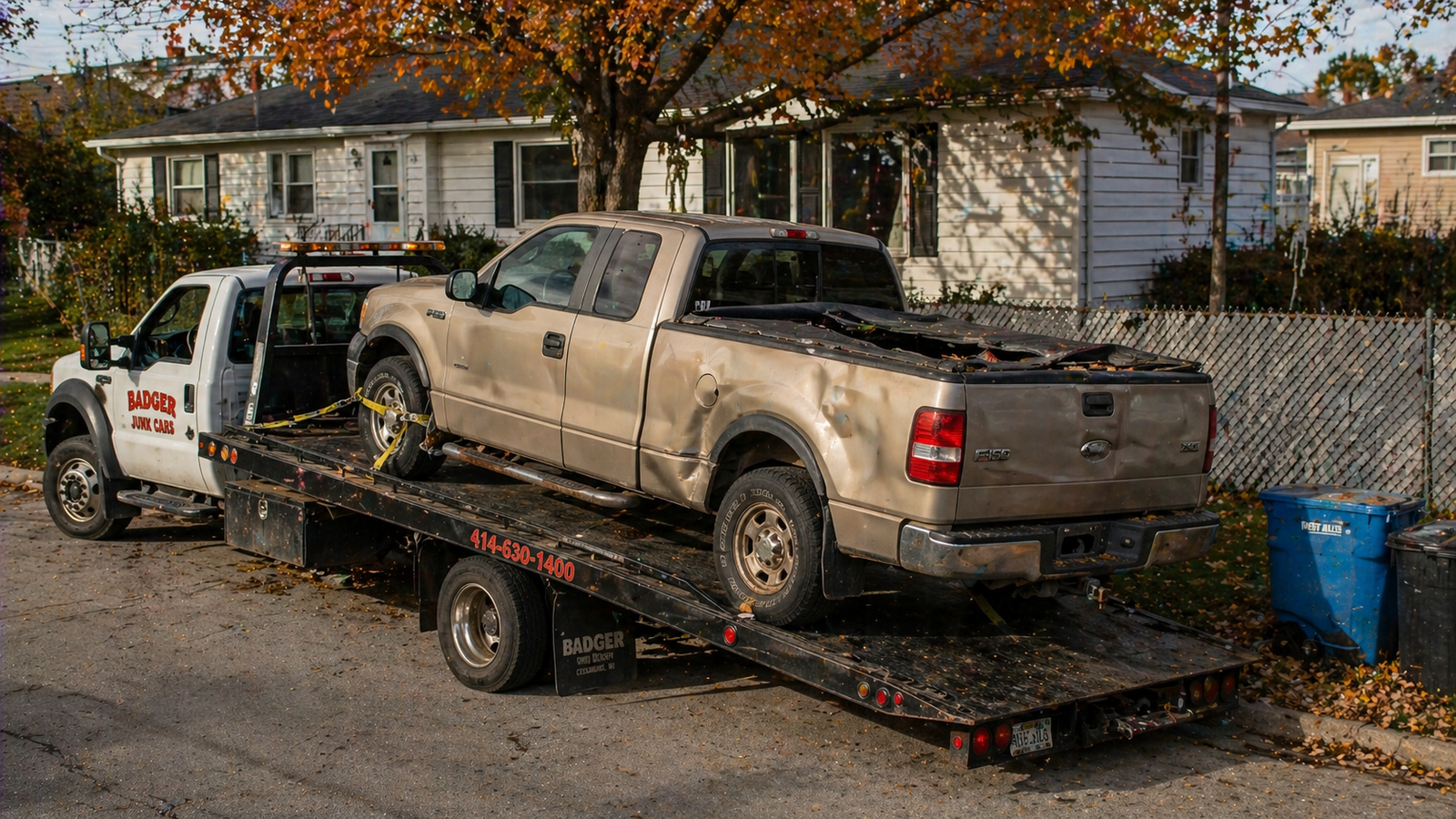
Half the cars we take out of Tosa aren't at the curb. They're at the end of a long pre-war driveway, backed up to a detached garage, flat-tired and dead for years. That's the pickup we're set up for — and it doesn't cost a dollar more than an easy one.
- ✓The winch, not the ignition — a car dead since 2019 leaves like a running one01
- ✓Flat tires and no keys are not obstacles02
- ✓Quote = payout, the driveway never changes it03
7 AM – 9 PM
The Tosa blocks
we already run
Search from a Wauwatosa address and most results are companies driving in from somewhere else. These streets are already on the route. One thing worth mentioning when you get in touch: where the car actually sits — not the address, the spot. A vehicle at the curb and one tucked against a garage at the back of a fifty-foot drive are the same quote and two entirely different pickups.
53213 · East Tosa
The Village, Highlands, the parkway
The curving 1920s streets of Washington Highlands, the blocks along the Menomonee River Parkway, and the tight older grid near Harwood Avenue. Short drive, awkward driveways — the two usually go together here.
Streets we run
53222 · North Tosa
North Avenue up to Center Street
Postwar blocks with more room on the apron and a fair number of second cars that stopped being second cars a while ago. Straightforward curbside loads — the easiest ZIP to schedule at short notice.
Streets we run
53226 · West Tosa
Mayfair, Watertown Plank, the Med Center
Out past the Mayfair Road corridor toward Watertown Plank Road and the Regional Medical Center campus. Wider lots, longer drives, and a good share of vehicles off the road since a repair estimate came back too high.
Streets we run
Getting a flatbed down
a narrow Tosa driveway
Wauwatosa was platted long before full-size trucks, and it shows. The truck never enters the driveway — it sits at the curb and the winch line runs up the drive to the car, drawing it forward onto the deck along the same line it would have been driven out. Nothing needs to start, steer or brake. Flat tires go under wheel dollies first, then the same pull applies.
The spots this covers
Nose-in, garage-kept, wedged behind a duplex
Nose-in against a detached garage at the back of a fifty-foot drive. Parked inside a garage that hasn't opened in two winters. Wedged behind a duplex off the State Street corridor. Up on an apron a foot narrower than the car is wide. None of it is unusual, and none of it is a surcharge — the estimate comes from the vehicle, not the driveway.
What actually helps
Three small things, and that's the list
Move whatever is parked in front of it, if anything. Take your things out of the glovebox and the trunk. Unscrew the plates — in Wisconsin they belong to you, not the car. Nobody needs the garage cleared out or the interior vacuumed; it's going to be scrapped for metal, and it's priced that way.
The Tosa second car that
quietly stopped running
Removal work here is steady, and it isn't mysterious. A settled, built-out inner-ring suburb accumulates vehicles the way a house accumulates furniture — slowly, then all at once when somebody finally looks in the garage. Almost none of these cars die of an engine failure. They die of salt.
The commuter
Replaced, never sold
Bought to save the good car from a long drive, kept going for years past the point of sense, then parked one evening and never started again. Usually the newest and heaviest thing on this list, which tends to make it the most valuable.
The college car
Left behind on the apron
Someone's first car, insured off years ago, still on the apron because moving it needs a jump, a tow, or a conversation nobody wants to have. It doesn't need any of those — it needs a phone call.
The work truck
Failed once too often
Work vans and pickups reach a repair estimate that finally outruns the vehicle's worth, then sit while somebody decides. They carry the most recoverable weight on a Tosa block, so the deciding is often the expensive part.
What a Tosa vehicle is worth,
and what shifts it
Cash for a Wauwatosa vehicle typically lands between $200 and $2,500, counted out at the curb. The spread is wide because vehicles are — here's what decides where yours sits.
Estimated spans · priced per vehicle on a fleet lot · nothing deducted for the tow
What shifts the figure
Weight, first. A full-size truck or van holds more recoverable steel and aluminum than a compact. This is the single largest factor and there's nothing subtle about it.
Everything still bolted on. Converter, wheels, battery, alternator, starter, drivetrain — a car nobody has taken parts off is worth noticeably more than the same car after somebody has.
A strong week on the market. Steel, aluminum and copper are quoted daily and the outlets we sell into move with them. The same vehicle can be worth more this Thursday than last.
Being close in helps the clock, not the price. Wauwatosa is one of the shortest hauls on the map, so same-day is genuinely routine here. The tow is included regardless of distance and never quietly subtracted — proximity means the flatbed turns up sooner, not that your offer changes.
How the sale actually goes
Three steps, and none of them asks anything unusual of you. The only Tosa-specific part is the second sentence of step one. Nothing gets reopened once the truck is there — what was agreed on the phone is what gets paid.
Send the details, including where it sits
Year, make, model and an honest condition note gets you a figure. Add one line about where the vehicle is parked — curbside, halfway down the drive, or nose-in against the garage — because that decides which truck and which gear leave the yard.
The driver plans the pull before arriving
Tosa is a short run up the interstate, so the pickup is usually the same day. The approach is worked out in advance rather than improvised in your driveway, and nothing about a tight spot changes the figure you were quoted.
Sign, take the cash, and it leaves
The driver checks the vehicle against your description, you sign the transfer and hand over the keys if you still have them, and the cash is counted out at the curb. No keys and no title are both workable — neither stops the sale.
Tosa in the middle of it
Wauwatosa is one stop on a map that runs roughly forty miles out from the yard. What actually differs between these places is how soon a truck reaches you, and very little else — the way a vehicle is priced doesn't change by municipality, and neither does who pays for the flatbed. On a border street and not sure which side you're on? It makes no difference; give dispatch the cross streets.
Wauwatosa junk-car
questions, answered
Five that come up more here than anywhere else on the map — four of them about getting the vehicle out rather than the money.
Every question we get asked →Yes — that's the standard Tosa pickup. The truck stays at the curb and the winch line runs up the drive, drawing the car straight out along the line it would have been driven. A closed garage, a fifty-foot drive, or a spot behind a duplex all come out the same way.
Completely routine. Flat tires go under wheel dollies, seized brakes and a missing key change nothing, and the winch does the pulling. A car dead since 2019 loads the same as one that drives on.
Just move anything parked directly in front of the vehicle, if anything is. The garage doesn't need clearing and the car doesn't need cleaning — it's priced as scrap metal either way. Pulling your plates is the one thing worth doing.
Usually the same day. Wauwatosa is a short run up the interstate from the yard, so same-day is routine here rather than dependent on the hour — a morning call is the surest route to a same-afternoon slot.
Workable. Wisconsin routes a replacement through the registered owner, so whose name the car is still in is the first question. Raise it on the opening call and we'll tell you what to gather before a truck is scheduled — a missing document has never changed what the metal is worth.
The rest of the site,
in one place
Three ZIPs, one crew
Get your Wauwatosa
cash offer today
Send the year, make, model, condition — and one line about where the car sits. Back comes a figure, a same-day window, and a flatbed with the right gear already on it. See how we move a car that can't roll or the full coverage map.
530 S Muskego Ave, Milwaukee, WI 53204
Open every day · 7 AM – 9 PM