Cash for junk cars in
Oak Creek — one or a yard full
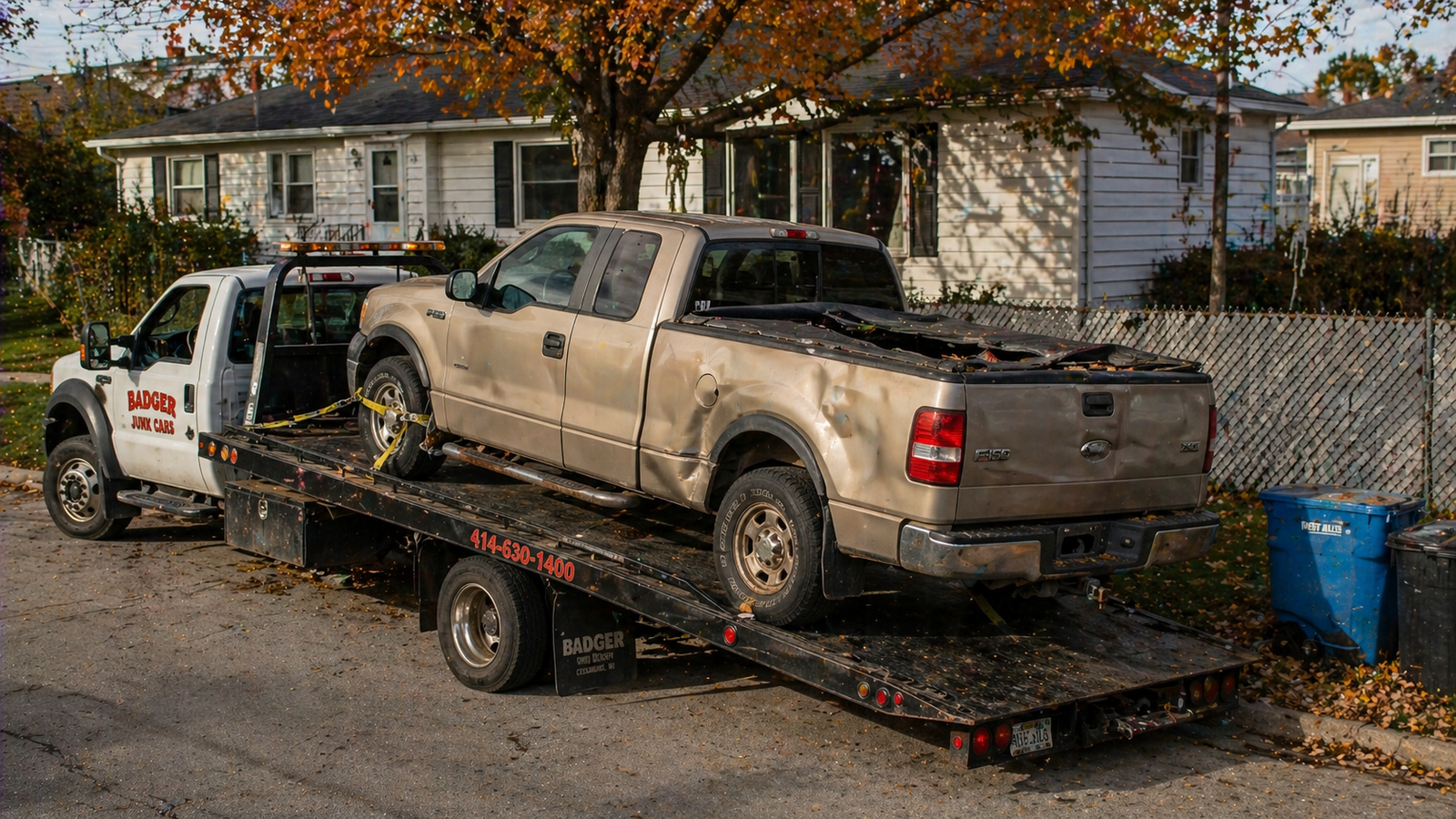
Oak Creek sends us two completely different calls: a dead second car on a driveway apron west of the interstate, and a contractor clearing six retired work vans off a lot near Ryan Road. Both get the same flatbed, the same free tow, and cash at the vehicle.
- ✓One vehicle or twenty — priced per unit, quoted as one figure01
- ✓Yard clear-outs staged so you aren't blocked all day02
- ✓$0 for the tow, either way03
7 AM – 9 PM
Why Oak Creek produces two
very different junk cars
Most suburbs generate one kind of scrap vehicle. Oak Creek generates two, because it's a fast-growing residential city bolted onto a long-standing industrial base — and the two sides retire vehicles on completely different clocks. What both have in common is winter: chloride road salt works upward into rocker panels, brake lines and frames, and by the time the rust is obvious the repair is worth more than the vehicle.
West of the interstate
The subdivision trade-in
New tracts keep filling in west of the highway and around Drexel Town Square, and households in a growing suburb cycle through cars fast. A commuter sedan traded up and never sold on; a second car outgrown; an SUV that lost an argument with a decade of winter chloride. Usually one vehicle on a driveway apron, often unmoved for a year.
On the ground
Toward the interchanges
The retired work vehicle
The other side is warehouses, contractors and distribution yards along the industrial belt. They retire vehicles the same way a household does — several at a time, on a schedule somebody manages. Box trucks run out of life; cargo vans that won't pass inspection; work pickups parked in a back corner.
On the ground
Quote, pickup, cash
The same three steps whether it's one car on a driveway or a row of vans behind a warehouse. Only the second step changes shape.
Send the year, make, model and condition
A VIN sharpens the number if you can reach it, and for a yard full of vehicles a list of units works just as well. The figure is built from what each vehicle weighs, how complete it is, and what the metal is trading at that day.
Take a pickup slot the same day
Oak Creek is a straight run down the interstate from the yard, so it gets scheduled as its own stop rather than held for a weekly route. For more than one vehicle we agree a staging order first so a working yard isn't blocked all day.
Sign at the vehicle and take the cash
The driver checks each vehicle against the description, the transfer is signed there, and the cash is counted out before the flatbed loads. Nothing comes off for the tow, and pulling your plates beforehand is the one thing worth doing in advance.
Clearing a yard,
not just a driveway
A business retiring six vehicles has a problem a household doesn't: the yard still has to work while they go. That's a scheduling job as much as a towing one, which is why this gets planned rather than improvised. Free towing covers commercial pickups exactly as it covers residential ones. Commercial vehicles are heavy and usually complete — fleet vehicles get maintained rather than parted out — so the numbers are usually good.
Stage one
Walk the lot, tag the units
Send a list or we come and look. Each vehicle gets identified by what it is and what state it's in — a dead box truck and a stripped van are not the same number.
Stage two
One figure for the lot
Every unit is priced on its own weight, condition and what's still on it, then the lot is quoted as a single total you either take or don't. The per-unit breakdown comes with it, so you can see where the money is.
Stage three
Agree the order they leave in
The part that matters to you: we take the units blocking things first, in an order you set, across as many loads as it takes — rather than shutting a corner of the lot for a day.
Stage four
Paperwork and payment once
One transfer packet, one payment, at the end. Not a separate transaction per vehicle, which is what turns a five-unit clear-out into somebody's whole afternoon.
What an Oak Creek
vehicle pays
Estimated spans, not guaranteed offers — the number for a specific vehicle comes from its weight, its completeness and the day's market. Nothing is deducted for the tow, residential or commercial.
Estimated spans · priced per vehicle on a fleet lot · nothing deducted for the tow
What sets the figure
Weight. The floor under everything. More vehicle, more recoverable metal, and it's not a subtle effect — a pickup sits near the top because it simply weighs more.
Completeness. Every component still attached is credited. The converter is the single largest line on most vehicles, and it's broken down on the valuation page.
The market. Steel, aluminum and copper are quoted daily. The same vehicle is worth a little more some weeks than others.
Commercial units cluster at the top. Box trucks, straight trucks, cargo vans and work pickups don't have a scale of their own — they sit at the upper end of the same one. Heavy, complete, rarely parted out: three things that push the same direction. Body damage and rust barely move these numbers by comparison.
Oak Creek on the south leg
We cover a circle of about forty miles with the yard at its center. Oak Creek sits about eleven miles out on the south run — close in, and on the same straight line the trucks already take toward Racine and Kenosha. That's the practical reason it gets same-day service as its own stop. Everything on the map is covered on identical terms; what changes with distance is how soon a flatbed reaches you, and nothing else.
Oak Creek junk
car questions
Five we field from this city, from driveways and from lots alike.
Every question we get asked →Typically $200 to $2,500 for a car, and commercial units cluster at the top of that scale because they're heavy and usually complete. The exact figure comes from the vehicle's weight, how complete it is, and the day's metal market — an estimate, not a guarantee.
Yes — that's a routine Oak Creek pickup. We tag each unit, quote the lot as one total with a per-unit breakdown, and agree a staging order so the units blocking things leave first and your yard keeps working. One transfer packet and one payment at the end.
Yes. The newer tracts west of the interstate have tighter turning circles and narrow aprons, so the driver winches the vehicle out to the street rather than manoeuvring across a lawn or a neighbour's curb. Say it's a tight spot and the right approach is planned before the truck sets off.
Yes — residential or commercial, one car or a full lot. Oak Creek is about eleven miles down the interstate, and the drive is our cost, never deducted from what you agreed to.
Yes to all three. We won't ask you to start or move anything — the flatbed and winch handle a car that can't roll or steer, and a seized, wrecked, or flooded vehicle is priced on its metal and recoverable parts.
The rest of what
we handle
One vehicle or the whole back corner
Get your Oak Creek
cash offer
Year, make, model and condition for a single car — or a list of units for a lot. Back comes a figure, a collection window, and a truck nobody charges you for. See every vehicle type we buy or the full coverage map.
530 S Muskego Ave, Milwaukee, WI 53204
Open every day · 7 AM – 9 PM