Junk cars for cash in
Kenosha — paid before it loads
Kenosha is the furthest point we run to, and the only city on our map where half the driveways have a car with out-of-state plates. Neither fact costs you a dollar — one is our fuel bill, the other is a paperwork question.
- ✓Wisconsin and Illinois plates both handled01
- ✓Flatbed at no charge02
- ✓Counted out at the curb03
7 AM – 9 PM
A city where the paperwork
comes from two states
Everywhere else we buy, a vehicle's documents came from one place. In Kenosha they routinely didn't — people commute across the line, move up over it, and keep driving what they arrived in. It's the single thing that makes this page different from the rest of the map. The state on the document changes what gets gathered beforehand, not the number on the offer.
Wisconsin side
The ordinary version
Wisconsin title in your name, plates issued here, address on the registration matching the driveway. Nothing about this is Kenosha-specific, and it's how the majority of pickups down here still go. Sign the title over at the curb, hand the keys across if they exist, take the cash.
Illinois-plated in a Wisconsin driveway
The version we only meet here
A car titled in Illinois, sitting in Kenosha, sometimes for years after the owner moved up. It's still a vehicle we can buy — the state on the document changes what gets gathered beforehand, not the number. Say so on the first call: a five-minute conversation before a truck is booked, and a wasted trip if nobody mentions it until the flatbed is outside.
A plant town
that kept its cars
Kenosha built vehicles for most of a century — the Nash and later American Motors works, then Chrysler engines until 2010. That history did something specific: this is a city where people bought a vehicle and simply kept it, often through two owners in the same family. Nothing about age reduces an offer on its own. What arrives on the flatbed is heavier on high-mileage sedans and old work trucks than three-year lease returns — complete, though.
The plant-town fleet
Kept, not traded
People bought a vehicle and kept it, often through two owners in one family. High-mileage sedans and old work trucks rather than lease returns — and complete, which is what a figure is built on.
And then there's the lake
Salt from underneath
Kenosha sits directly on Lake Michigan, and the streets nearest the water take the whole winter cycle of damp air and heavy salting. Floor pans, fuel and brake lines, rockers — the damage starts underneath and is well advanced before it's visible.
None of it dents the figure
Metal plus what's bolted on
What we pay for is recoverable metal and the components still bolted on, and corrosion from below removes very little of either. A car that looks past saving still quotes at a real figure.
Ranked by what
they usually bring
Six shapes of vehicle, heaviest earner first. These are the bands we typically land inside, not a price sheet — the weight, how complete the vehicle is, and what metal's trading at decide where in the band yours sits.
Estimated spans · priced per vehicle on a fleet lot · nothing deducted for the tow
What moves a vehicle up its band
Completeness, not condition. An engine that hasn't turned since 2019 costs you nothing. A missing exhaust section, absent wheels or a removed battery all do, because each was part of what we were buying.
The reverse is worth saying plainly: pulling parts off before we arrive nearly always returns less than leaving them attached, and it turns a firm quote into a re-quote at the curb.
Describe the vehicle honestly and the figure quoted on the phone is the figure counted out beside it. There's no second inspection, no deduction at the yard, no call back afterwards — and the run back up the interstate is our cost, not a deduction.
One call, one visit,
one payment
The sequence is identical whether the vehicle's a mile from the yard or at the far southern end of the county. The only Kenosha-specific step is the middle one, and it's about documents rather than money.
Say what it is and what's left on it
Year, make, model, and whether the exhaust hardware, wheels and battery are still fitted. A VIN sharpens it. You get a figure on that call rather than a range to be revised later, so the description is worth getting right.
Sort the document question before the truck moves
Tell dispatch which state issued the title and whether it's in front of you. Wisconsin, Illinois, or missing entirely are all conversations worth having at the booking stage rather than on the driveway, because it decides what you need to hand over.
Take the cash before it goes on the deck
The driver confirms the vehicle matches what you told us; the transfer is signed where you're standing and you're paid before the winch is touched. The run back up the interstate is our cost, not a deduction.
Four codes, and
everything around them
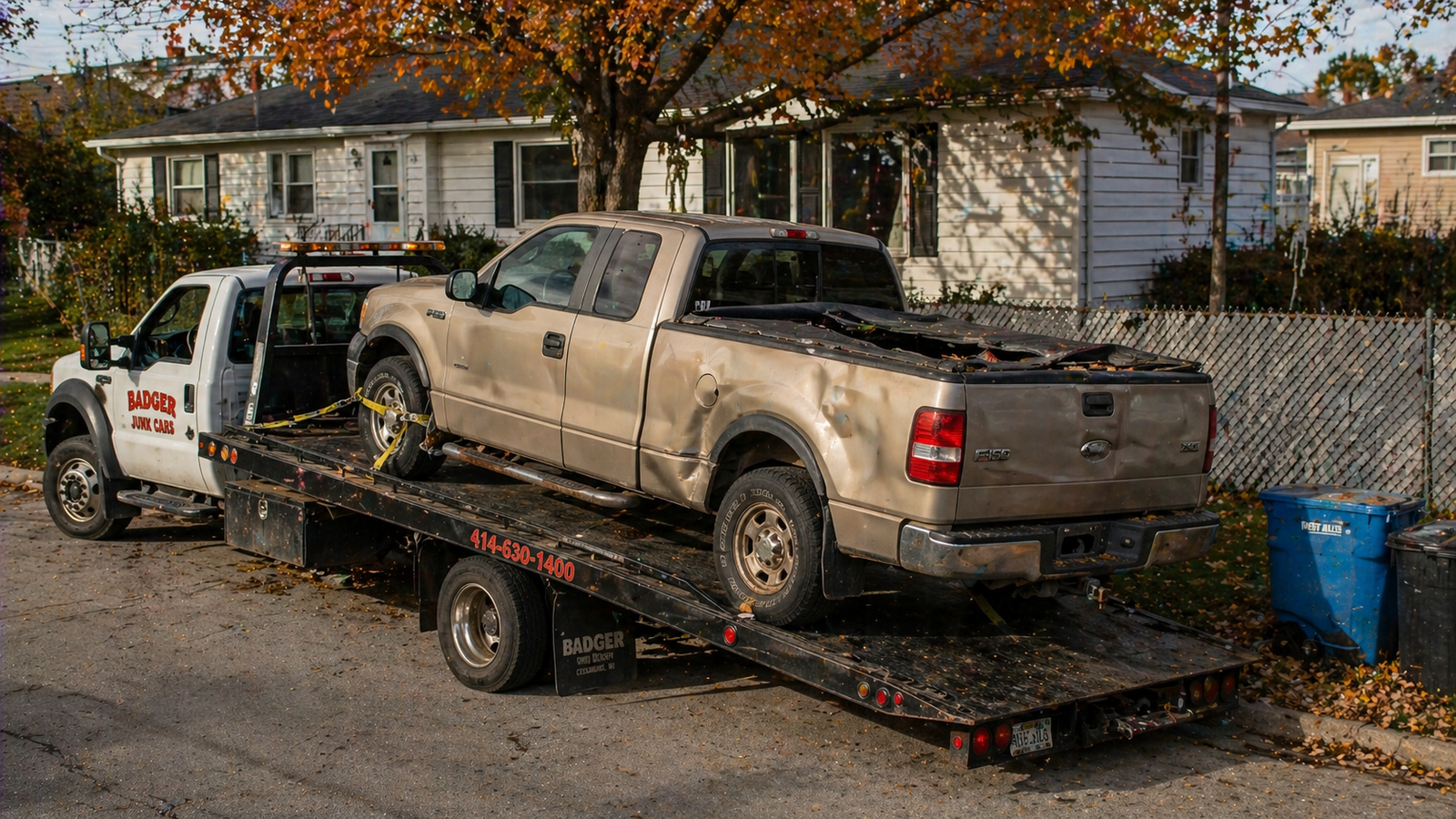
The city runs from the lake out to the interstate, and the whole width of it is one pickup area — including the county towns beyond the city limit. Why the deck truck, every time: nothing has to start, steer or hold air. Boxed in behind two other vehicles, sunk into a back yard, sitting on flat tires since the last jump attempt — those are ordinary jobs here, not exceptions we charge extra for.
53140 · North & downtown
Toward the harbor
The downtown blocks and older streets running north off Sheridan Road toward the harbor. Tight alleys, short aprons and a lot of detached garages — mention which it is when you book.
On the block
53142 · West & interstate side
Off I-94
Newer subdivisions out toward I-94 and the commercial strip along Highway 50. Wide drives, easy turning room, and the quickest part of the city for us to reach.
On the block
53143 · South & lakeside
Deepest salt damage
The streets south of downtown and the blocks closest to the water. Where the salt damage runs deepest, and the largest share of long-parked, no-longer-starting vehicles.
On the block
53144 · Northwest
The 52nd Street run
Longer-settled residential blocks either side of the 52nd Street run. Straightforward loads, and the easiest half of the city to fit into an afternoon.
On the block
Plates, paperwork,
and which state issued it
Three things are worth doing at a Kenosha pickup that nobody thinks about until afterwards. None takes more than a minute while the driver's still there — and all three are considerably more annoying to sort out once the vehicle has gone. An Illinois title on a vehicle parked in a Wisconsin driveway is the most common paperwork question we get here, and it's not a problem — just a different set of documents to have ready.
Take the plates off yourself
Wisconsin plates are yours
Wisconsin treats the plates as yours, not the vehicle's — they come off before it loads and stay with you, to move onto whatever you drive next or hand back to the DMV. A plate that leaves on the deck is one you have to explain later.
Illinois plates go back to Illinois
Same principle, different state
If the vehicle's wearing plates issued across the line, they're not ours to take and not the vehicle's to keep. Pull them, keep them, and deal with the issuing state directly — we can tell you what we see, but that side is between you and them.
Close the record with the state
A short, free online step
Once you've been paid, tell the DMV the vehicle is no longer yours. It's a short online step, it's free, and it's what stops a vehicle you sold in July turning up attached to your name in October.
If the title's gone missing
Replaced through the owner
A lost document is replaced through whoever the issuing state lists as its owner, so bring a photo ID and whatever ownership paperwork survived. Say so on the first call and we'll tell you what to gather.
Everything inside the line
Around forty miles out from the yard in every direction — and in this direction it stops at the Illinois line rather than at a distance. Kenosha is the last band before that edge. The truck turns around at the state line, so a vehicle at an Illinois address isn't one we can collect — a limit worth being straight about. What we do take routinely is a vehicle titled or plated in Illinois that's parked on the Wisconsin side.
Kenosha junk
car questions
The five things people ask before a truck is booked down here.
Every question we get asked →No — it's the most common paperwork question we get in Kenosha, and it's routine. The state on the title changes what you gather beforehand, not the number on the offer. Tell dispatch which state issued it and whether you can put your hands on it, and we'll tell you what to have ready. A vehicle at an Illinois address is different — we stop at the state line — but Illinois paperwork on a car in a Wisconsin driveway is fine.
We come — Kenosha is the far end of the map, so pickups are grouped onto runs already heading south down the interstate, which keeps it on same-day service where the day allows rather than a weekly trip. A morning call gives the widest window.
Yes — that's an ordinary Kenosha pickup. The deck truck winches a vehicle up with its wheels off the ground, so flat tires, seized brakes, and a spot behind the house or boxed in behind other cars are all handled. Describe the spot honestly and the right truck turns up first time.
Completeness, mostly. An engine that hasn't turned in years costs you nothing, but a missing exhaust section, absent wheels or a removed battery each come off — they were part of what we were buying. Weight and the day's metal price set the band; what's still bolted on sets where in it you land.
Yes — multiples get one collection window rather than a separate visit each, and RVs, boats and fleet lots are quoted per unit on the same basis as a car. Say how many when you book so the right truck and window are set.
The rest of the
network, in one place
The mileage is on our side of the ledger
Get your Kenosha
cash offer
Tell us the vehicle, what's still bolted to it, and which state the title came from. You get a figure on that call, a same-day window where the day allows, and a flatbed nobody bills you for. See how the no-title paths work or the full coverage map.
530 S Muskego Ave, Milwaukee, WI 53204
Open every day · 7 AM – 9 PM