Cash for non-running cars in Milwaukee
Won't turn over, stalled for good, or dead in the driveway since the cold snap. We quote it, winch it, and hand you cash at the curb.
- ✓No jump-start, no limping it to a shop01
- ✓Flat tires and locked wheels are routine02
- ✓The recovery costs you nothing03
7 AM – 9 PM
We buy cars that won't start,
whatever's wrong
The reason your car stopped running doesn't change whether we'll buy it. You don't need to fix anything, or even know what failed. Dead battery, no-crank fault, blown starter, dead alternator, seized engine, bad transmission, never diagnosed — all bought.
Symptom 01
It clicks but won't turn over
Usually a dead battery, a failed starter, or a corroded ground. The rest of the car is generally untouched — which is the mildest version of this problem, and the one where the drivetrain is worth the most.
Symptom 02
It cranks but won't fire
That points at fuel, ignition, or timing. Somewhere between an afternoon's work and a bill nobody wants to pay — and by the time a car has been sitting through a winter on this fault, most owners have stopped chasing it.
Symptom 03
It does nothing at all
No lights, no click, no sound. Almost always electrical, and almost always the point where a car gets left where it sits. It still has a VIN, still has steel, and still has parts worth money.
How selling your
non-running car works
Quote, same-day pickup, cash when we load it. No back-and-forth and no fee at any point in it.
You get a quote
Year, make, model, and a quick description of the condition — what's missing, what's damaged, and whether the converter and wheels are still on it. A VIN alone usually does the job.
The figure we give is a typical estimate for that specific car, not a placeholder we walk back later.
We schedule pickup
Usually the same day you reach out. Towing is always part of the deal, so the quote you accept is the cash you get, with nothing subtracted for the recovery.
You don't need to:
You get paid at the curb
The crew arrives, loads the vehicle, you hand over whatever you have for proof of ownership, and the cash goes in your hand on the spot.
Missing paperwork isn't a stopping point — flag it while we're quoting and the driver arrives knowing what to expect. If a title's gone missing, we'll tell you what your vehicle needs on the first call.
Where we pick up dead cars
around Milwaukee
Out to roughly 40 miles of the city, and the recovery is free everywhere in that range.
Red chips have their own pickup page · plain chips are covered identically
Free towing means the recovery cost never comes out of your payout, whether the drive is ten minutes or forty. The quote is built on the car itself, not on how far we drive to reach it.
Inside the city we pull vehicles from Bay View, Riverwest and the South Side, along with the near suburbs — West Allis, Wauwatosa, Greenfield and Cudahy. Farther out: Oak Creek, Franklin, Brookfield, New Berlin, Menomonee Falls and into Waukesha County.
Cold weather is our busy season for a reason
A battery that was marginal in October is finished by January. A starter that was slow all autumn gives up on the first genuinely cold morning. Then the car sits, the tires go flat, and by spring it isn't a car that needs a jump — it's a car that hasn't moved in six months. If that describes the one in your driveway, you're inside our area.
Non-running, mechanically dead,
or true junk?
Knowing which kind of non-running your car is explains its offer. The difference is how much of the drivetrain is still worth reusing versus recycling. You don't have to diagnose it correctly to sell it — you describe what the car does and doesn't do, the driver sees it in person, and the offer reflects what's actually left to recover.
Bucket 01 · Mildest hit
Electrical non-runner
Dead battery, bad starter, blown alternator, a wiring fault. The engine and transmission are fully intact and untouched — the car simply can't wake up to use them.
Still recoverable
Bucket 02 · The middle case
Mechanically dead
A seized engine or a failed transmission. Selling one of these means selling everything around the failed part — and on a dead transmission it works in reverse, with the engine carrying the value instead.
Still recoverable
Bucket 03 · Far end
True junk
Stripped, crushed, rusted through, or already picked over for parts. Worth its recoverable metal and little else — but even that isn't zero.
Still recoverable
How we tow a car that
can't roll or steer
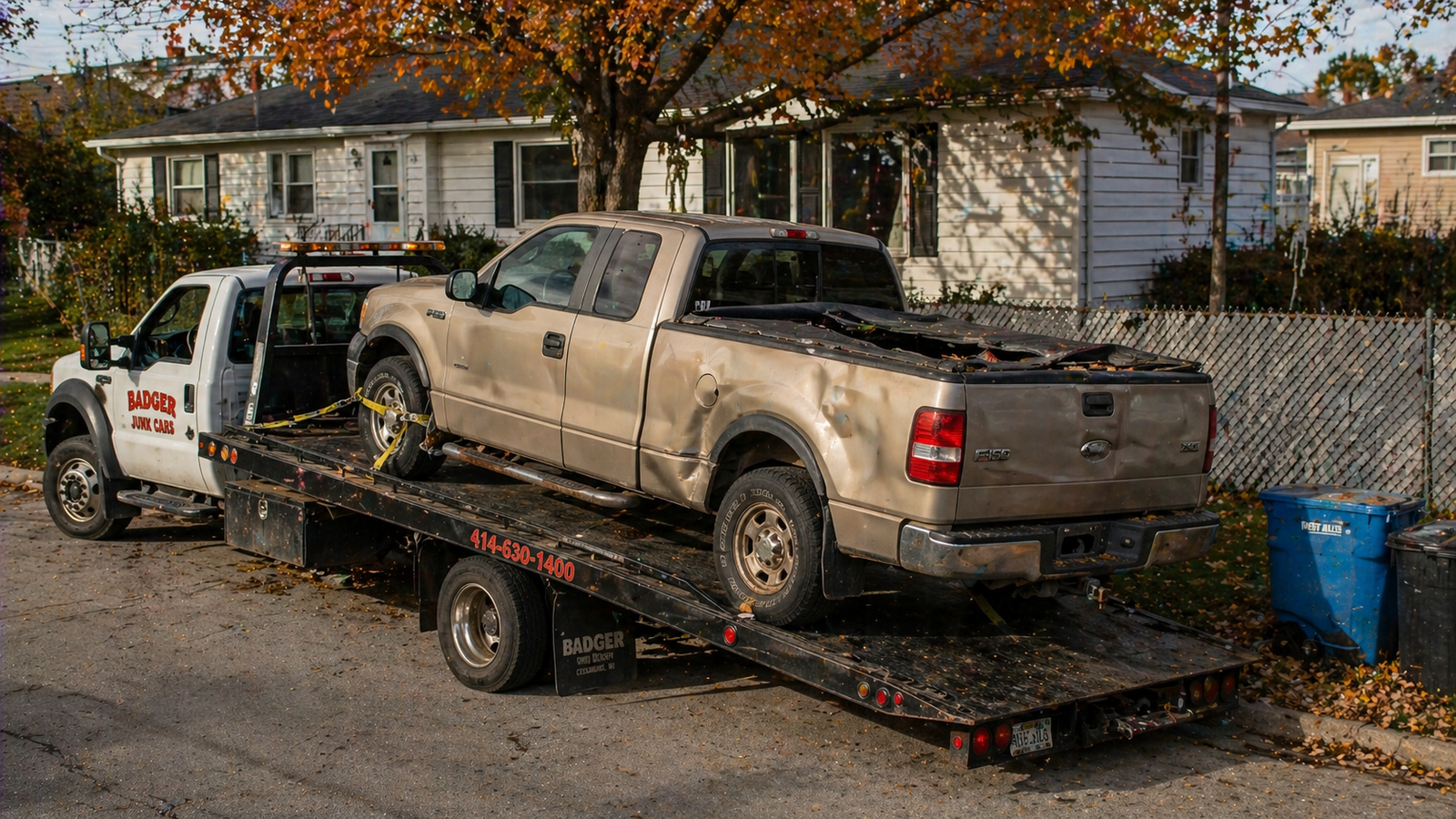
Seized wheels, a locked parking brake, flat tires, a dead steering column. So we don't drive it or push it — we pull it, on a tilt-deck flatbed. A car that can't move under its own power loads the same as one that drives on.
Step 01
The deck comes down to the car
The bed tilts until it meets the ground at an angle. The car is never driven onto a lift — which is why a vehicle that hasn't moved in years can still be recovered.
Step 02
A steel cable hooks to the frame
Not the bumper, not the axle — a hook point on the frame that can take the pull. This is the only moment the driver needs to get under the car.
Step 03
The winch drags it up
Slowly, with the wheels locked solid if that's how they are. Flat tires, a seized hub, a parking brake nobody can release — none of it stops the cable. The car comes out straight back, along the line of the cable, so a tight driveway or a closed garage is no obstacle.
Non-running car
questions, answered
The six we field most often from owners with a car that won't start. Something else? Ask dispatch.
Run yours through the value estimator →A buyer who scraps the vehicle itself and prices it on real recoverable value — the metal by weight, the converter, and the reusable parts — rather than a flat per-car number. A complete car that simply won't start is worth more than a running car that's been picked over, so completeness matters more than whether it starts.
We do, seven days a week, across the metro. You give the year, make, model and what the car does or doesn't do; we quote a typical figure; and if it has a VIN we can buy it. The flatbed comes to the car and you're paid at the curb.
At the yard at 530 S Muskego Ave in Walker's Point, or without leaving home — most sellers never bring the car anywhere. We come to the driveway, the back lot, or the garage, load it, and pay you there.
Call or request a quote with the basics, accept the number, and we schedule a same-day pickup. You don't jump it, move it, or fix anything. The tow is free and never deducted, so the quote you agree to is the cash you get.
Wisconsin normally completes a sale on the title, and a registered owner whose copy is missing can request a replacement. It's not a dead end — raise it on the first call and we'll tell you exactly what your vehicle needs before the truck is booked.
Typically $200 to $2,500 depending on the vehicle and what's left to recover — that's an estimate, not a guaranted number. The converter is the biggest single factor, then the wheels, battery, alternator and starter, then the metal by weight.
Why a dead car
is never worth zero
Most of what a buyer pays for has nothing to do with whether the engine starts. What lowers the number isn't the dead engine — it's missing parts. A complete car that simply won't start is in far better shape, from a buyer's point of view, than a running car someone has been pulling pieces off for two years.
Half one
The metal, which doesn't care
A vehicle is mostly steel, with aluminum in the wheels, engine and some panels, and copper through the wiring and motors. That mass is why a heavier vehicle quotes higher — and none of it notices that the key does nothing.
Still worth cash
Half two
The parts, which are still good
The converter is the biggest by a wide margin. Then the battery, the starter, the alternator, and a set of wheels that still hold air. And on a car that only died electrically, the whole engine and transmission are untouched.
Still worth cash
If yours isn't a car
that won't start
One call settles it
Get your cash offer on a
non-running car today
Won't start, won't move, hasn't run in years — the number we give you is the number you're paid, tow included. Running fine but done with it? Our full vehicle list covers every type.
530 S Muskego Ave, Milwaukee, WI 53204
Open every day · 7 AM – 9 PM