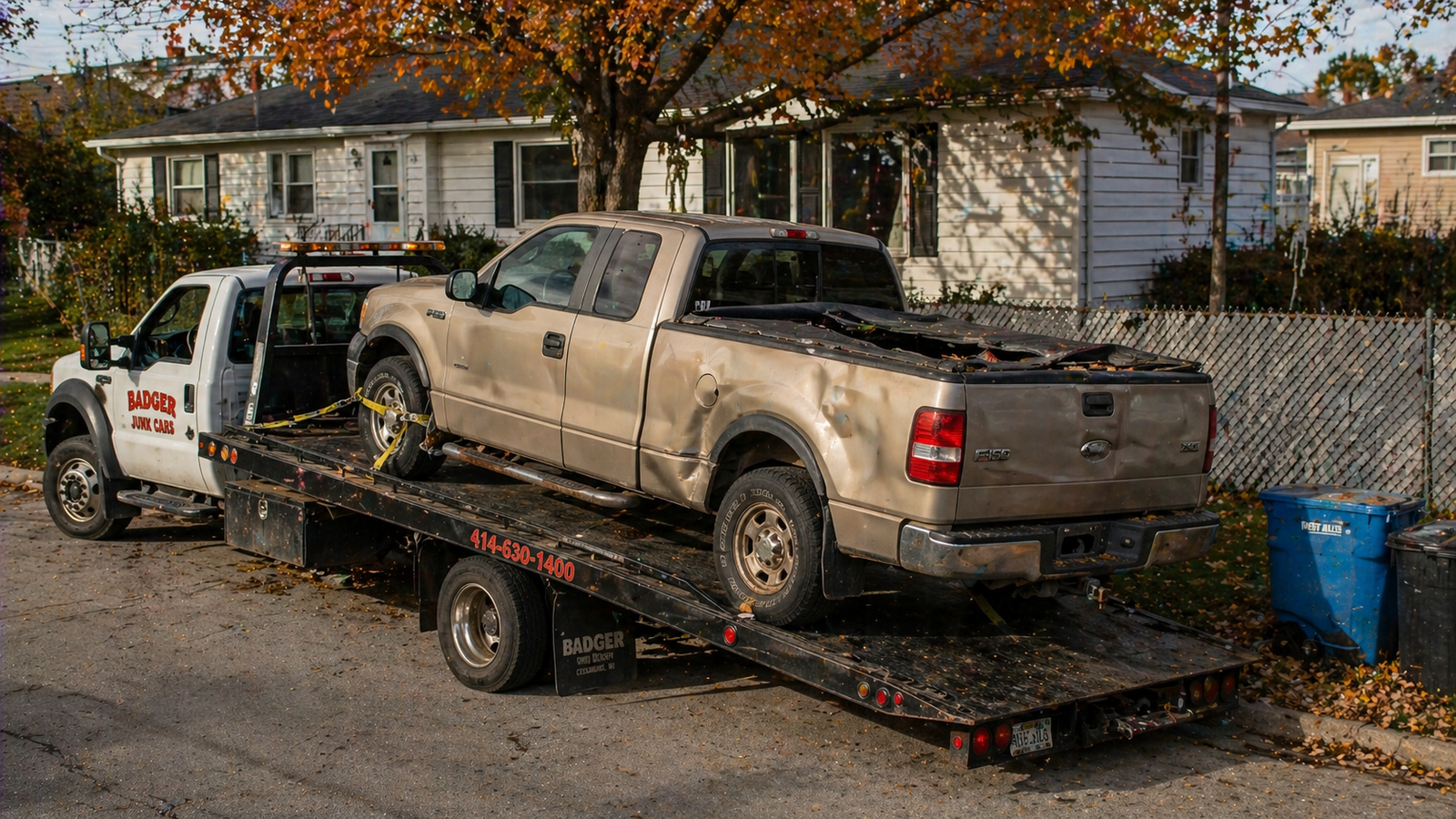
Sell a wrecked car in Milwaukee for cash
Collision, rollover, flood, or a car the insurer already totaled — we buy it as-is, and the crash doesn't take it off the table.
- ✓Salvage-title paperwork handled at pickup01
- ✓No repairs, no cleanup, as-is02
- ✓Paid on the spot, not by mailed check03
7 AM – 9 PM
Where we pick up
across metro Milwaukee
We tow wrecked cars anywhere inside roughly a 40-mile radius of downtown, and the tow rides along at no charge.
Red chips have their own pickup page · plain chips are covered identically
In the city we reach Bay View, Riverwest, and Walker's Point; West Allis, Wauwatosa, and Greenfield in the inner ring; Oak Creek, Waukesha, and Menomonee Falls beyond, down the lakeshore to Racine and Kenosha. Distance inside the radius doesn't change the offer or add a charge.
Boxed in, on a side street, or parked where it stopped after the accident — tell us when you call and the driver plans the load around it. Because the flatbed comes to the car, you never have to get a non-running wreck rolling or steer a crash-damaged one into traffic.
Southeastern Wisconsin's salted winters are one more reason a car that's already wrecked usually isn't worth repairing — it's worth selling.
Insurance total-loss and how
the salvage title works
"Totaled" means the repair estimate outran the car's cash value — but the car is still yours to sell unless you sign it over to the insurer.
Keep the car on what's called an owner-retained total loss and the insurer pays your settlement minus the car's salvage value — leaving you free to sell the wreck for that remaining value. That's the sale most people don't realize they can make: you collect from your policy and still get cash for the car.
In Wisconsin, a totaled vehicle is issued a salvage title — and that paperwork isn't something you sort out before we arrive. A salvage title doesn't take the car off the table; we buy on one, and the transfer gets handled right at pickup. Sign it over if you have it. If it's lost, or the car was never re-titled after the total, say so when you call and we'll tell you what Wisconsin needs for your vehicle before the truck rolls.
Bring the title, the total-loss letter, your ID — whatever you have — and we take it from there. The quote doesn't shrink because the title says salvage, and a wreck is priced on what's left of it, not on what the document says.
Two ways to sell a wreck,
with or without a payout
Every wrecked car ends up in one of two situations — and both of them end with us buying it. Which path wins comes down to whether filing nets more than your deductible and premium increase cost you. Either way, the wreck's salvage value is the same to us.
Path A — insurance involved
Claim settled, car kept
Your claim was paid, the car was called a total loss, and you chose to keep it rather than surrender it. The settlement check is already yours — and the car in your driveway is now just salvage. Sell it to us for its salvage value and you come away with both. This is the money most drivers leave on the table.
Path B — no claim at all
Skip the adjuster entirely
The car was old and not worth a comprehensive claim, you were at fault and uninsured for the damage, or you'd rather not watch your premium climb. So you don't file. No adjuster, no waiting on a decision, no repair estimate to chase — we quote the car on what it's worth as salvage and pay that. Often the faster, cleaner cash on an older car.
The wrecks we buy: collision,
rollover, flood, and totaled
C.1
Collision damage
Front, rear, and side hits are the most common — crumpled panels, a bent frame, deployed airbags, a cracked radiator leaking fluids. A collision car is still a full car's worth of steel, salvageable parts, and converter to a scrap buyer.
C.2
Totaled — by the insurer or you
"Totaled" is an insurance verdict, not a mechanical one: repairs would cost more than the car's cash value. We buy totaled cars whether the insurer made that call or you did, driving or not since the crash.
C.3
Rolled over
A rollover wrecks the roof, pillars, and glass and rarely leaves a car worth fixing — but the engine, transmission, wheels, and converter often come through intact. Tell us it rolled and it quotes like any other wreck.
C.4
Flood cars
The one damage type private buyers won't touch — water ruins electronics and leaves corrosion that keeps spreading. Storm, flooded viaduct, or a burst pipe at home: the metal, glass, and many mechanical parts are still worth cash, as-is.
Selling a wrecked car:
frequently asked
The master FAQ covers the rest — or raise it on the call, where the person quoting the car is the one answering.
The full guide to selling a junk car →Yes — non-running and totaled are ordinary here. A wreck is priced on what's left to recover: the metal by weight, an intact converter, and the reusable parts. Whether it drives doesn't change the salvage value, and the flatbed loads a car that can't roll the same as one that does.
Often, yes. Wisconsin normally completes a sale on the title — a salvage title after a total — and a registered owner whose copy is missing can request a replacement. Say so when you call and we'll tell you what your vehicle needs before the truck rolls.
Typically $200 to $2,500 depending on the vehicle, what the crash left intact, and the day's metal market — an estimate, not a guarantee. A collision that spared the converter, wheels, and drivetrain quotes well above one that didn't.
Yes to both. A rollover usually leaves the drivetrain and converter intact; a flood ruins electronics but not the metal, glass, and many mechanical parts. Both are bought as-is.
Yes, at every address in range, and it's never deducted from the offer. The car can sit exactly where the accident left it — we come to it.
Yes, as long as you kept it (an owner-retained total loss) rather than signing it over. You collect your settlement and still sell the salvage to us — two payouts on one car.
What a wrecked car
is actually worth
A wreck isn't just crushed metal — it's a set of parts, some ruined and some perfectly good. Only one of the four inputs is the raw metal, which is why two cars the same size, wrecked the same day, can be worth very different amounts. The metal sets a floor, the good parts and the converter lift it, and the specific car plus that day's market decide where in the range the offer lands.
F1
The car itself
Year, make, and model. Newer and more common vehicles, and trucks of any age, price higher because their parts are in demand.
F2
Curb weight
More recoverable steel and aluminum — why a full-size pickup outvalues a compact even when neither can be repaired.
F3
Condition & completeness
Where a wreck beats its scrap weight. An intact converter alone is often 15 to 40% of the total, and wheels, battery, alternator, and starter stack on top. A collision usually damages the body while leaving all of those fine.
F4
The daily scrap index
The live market rate for steel, aluminum, and copper. It moves day to day — a published figure, not one we invent — and it's one input of four, not the whole offer.
How it works: quote,
pickup, cash
Get a quote
Year, make, model, and VIN, plus a note on what's wrong — collision, flood, won't start. Priced from the car's weight, condition, and the day's market, with a real number back fast, not a callback later.
Schedule the same-day pickup
Take the offer and a flatbed heads out that day, anywhere in the metro. The car can sit exactly where it stopped after the crash — you don't move it, run it, or bring it anywhere.
Get paid cash at the curb
The driver confirms the car matches what you described, the title gets signed over — or the salvage paperwork completed, down to the bill of sale — and the cash lands in your hand. No mailed check to wait on.
One yard, every
kind of sale
The quote is free either way
Get your cash offer on
a wrecked car today
A caved-in front end, a salvage title, or no title at all is no problem — the number we give you is the number you're paid. Runs fine but you're done with it? Our full vehicle list covers running vehicles too.
530 S Muskego Ave, Milwaukee, WI 53204
Open every day · 7 AM – 9 PM