Sell your junk car in
Racine — cash the same day
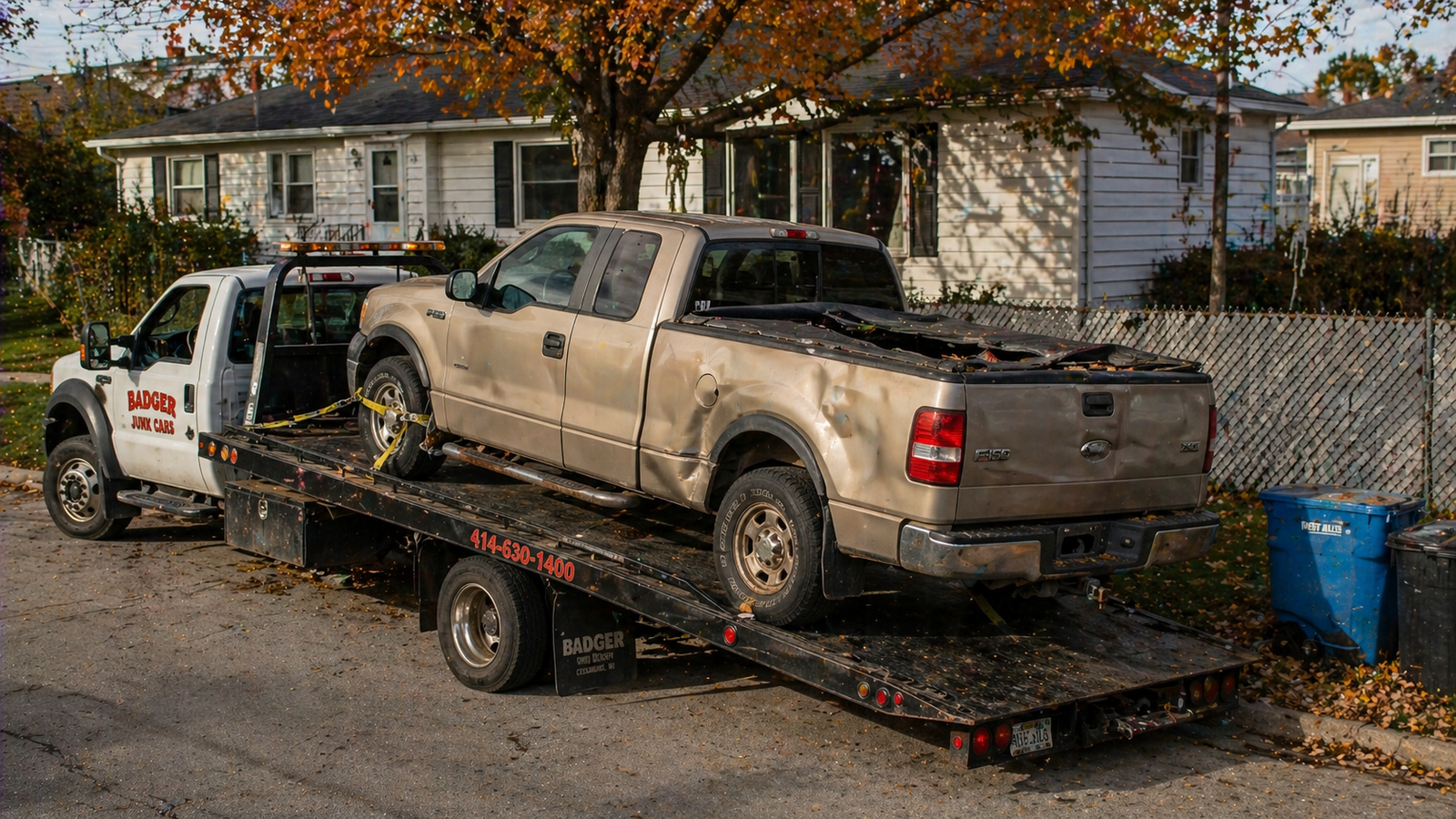
Racine has scrap yards of its own, so you have a real choice here that most of our map doesn't. Haul the car to a gate and get paid for what it weighs, or let us price the whole thing where it stands and pay the transport ourselves.
- ✓Quoted whole, not by the ton — weight plus what's attached01
- ✓Flatbed at no charge, the drive back north is our cost02
- ✓Cash where the car is03
7 AM – 9 PM
Racine is its own city,
and it behaves like one
This is not an outer ring of Milwaukee that happens to be far away. It's a separate lakefront city in a separate county, with its own downtown, industrial history and housing stock — and all three show up in the vehicles. Rust barely dents the number: the offer was never about the body, it's built on recoverable metal weight and the components still bolted on, and rust from underneath takes almost none of that away.
Older housing, longer driveways
Where a car can sit for years
A lot of pre-war and mid-century homes with detached garages and deep drives — the kind of place a project car or a dead daily driver can sit for years without anybody being forced to deal with it. The vehicles here skew older and higher-mileage.
A manufacturing city
Not a bedroom one
Racine grew around industry rather than around a commute, and the vehicle mix reflects it. More work vehicles, more long-owned cars, fewer three-year lease returns. Cars here tend to stay in one family until they're genuinely finished.
The lake gets underneath them
Damp air plus heavy salt
Winters on the lakefront combine damp air with heavy salting, and the two together go after rockers, brake lines and frames from below. A Racine car often looks fine from six feet away and is finished underneath.
A gate weighs it.
We buy it.
Both are legitimate ways to get rid of a car in this city. They just pay for different things, and the gap widens the less the vehicle is able to move under its own power. A gate pays for what the vehicle weighs once it's on the weighbridge. We pay for everything that's on it as well — and we absorb the moving. Because Racine has yards of its own, you genuinely could load it and take it to a gate, so it's worth being straight about.
Taking it to a yard yourself
Paid by the ton, at the gate
You're paid for what the vehicle weighs when it gets there, at that day's per-ton rate. Getting it there is yours to arrange and yours to pay for — for a non-runner at the far end of the county, not a small number. Components generally aren't priced separately; the scale doesn't know what's bolted underneath. It costs you the trip, the arranging, and usually most of a day.
Selling it where it stands
Quoted on the whole vehicle
Quoted on weight plus everything still attached — the converter (usually the largest single line), the drivetrain, the wheels, battery, alternator and starter, each credited individually. The flatbed is ours to send and ours to pay for, however far south you are. Nothing is deducted afterwards for the distance back north. It costs you a phone call and the time it takes a driver to load it.
What a whole-vehicle
offer adds up to
Typical spans by body type. Estimated, not guaranteed — free towing is already inside every figure, and you're quoted on the whole vehicle rather than what it weighs at a gate.
Estimated spans · priced per vehicle on a fleet lot · nothing deducted for the tow
Where the difference lives
A gate is buying recoverable metal weight — that's the base layer. A whole-vehicle offer adds everything above it: the catalytic converter (usually the largest single line), the drivetrain and heavy components if nobody's taken them, and the wheels, battery, alternator and starter credited individually.
On a complete car, that stack is not a rounding error. Which is why the first thing we ask is what's still on the vehicle — a car somebody's already taken the converter off is a different quote, and it's worth knowing that before letting anyone remove anything.
Describe the vehicle honestly and the figure quoted on the phone is the figure counted out beside it. Free towing is already inside every figure — the distance back north never shows up as a deduction.
What a whole-vehicle
offer adds up to
Typical spans by body type. Estimated, not guaranteed — free towing is already inside every figure, and you're quoted on the whole vehicle rather than what it weighs at a gate.
Estimated spans · priced per vehicle on a fleet lot · nothing deducted for the tow
Where the difference lives
A gate is buying recoverable metal weight — that's the base layer. A whole-vehicle offer adds everything above it: the catalytic converter (usually the largest single line), the drivetrain and heavy components if nobody's taken them, and the wheels, battery, alternator and starter credited individually.
On a complete car, that stack is not a rounding error. Which is why the first thing we ask is what's still on the vehicle — a car somebody's already taken the converter off is a different quote, and it's worth knowing that before letting anyone remove anything.
Describe the vehicle honestly and the figure quoted on the phone is the figure counted out beside it. Free towing is already inside every figure — the distance back north never shows up as a deduction.
Every corner of the city,
and the villages around it
Four ZIP codes cover Racine, and the surrounding Racine County communities sit on the same run. If you searched from a Racine address, you're inside the pickup area. It's always a flatbed here — flat or locked tires, seized brakes, a car that hasn't moved since somebody last tried to jump it. The winch pulls it on without dragging it down your drive or across the street, and the tight spots are worked out before the truck sets off.
53402 · North & lakefront
Toward the point
The blocks running north along the lake toward the point. Older streets, deep drives, and the most salt-damaged undersides in the city.
On the block
53403 · Downtown & south
Either side of the river mouth
The downtown grid and the neighborhoods either side of the river mouth. Narrow lots and tight alley access — worth flagging when you book.
On the block
53405 · West side
Room on the apron
Longer-settled residential blocks with room on the apron. Straightforward loads, and where a good share of the long-parked project cars turn out to be.
On the block
53406 · Western edge
Toward Mount Pleasant
Out toward the county roads and the Mount Pleasant line. Wider access and the easiest scheduling, since it's closest to the interstate.
On the block
How a pickup this far south
actually gets scheduled
Racine is a longer haul than a pickup in the inner suburbs, and pretending otherwise would just mean guessing at your arrival time. The routing is a problem on our side of the phone — it doesn't appear as a fee, doesn't appear as a smaller number, and the figure is locked the moment you accept it. One detail can move you up the day: mention the main road you're nearest — Washington Avenue, Durand Avenue, or wherever you sit relative to the interstate.
What we do
Group the lakefront jobs
Pickups along the lakefront get put onto the same routes rather than each triggering its own trip. That grouping is exactly what keeps a city at the edge of the map on same-day service instead of a waiting list.
What it costs you
Nothing, in either direction
The routing is a problem on our side of the phone. It doesn't appear as a fee, it doesn't appear as a smaller number, and the figure is locked the moment you accept it.
What helps
Calling earlier in the day
Not a rule, just arithmetic — a morning booking gives the crew more room to fit a southern stop in before evening. An afternoon call still usually lands today, it just has less slack in it.
Racine on the
lakefront run
Roughly a forty-mile radius around the yard, worked as legs. Racine sits on the lakefront leg — about 27 miles out, on the way to Kenosha — which is the reason a southern pickup isn't an expedition. Every leg is worked on identical terms: the tow is free across all of it, and the distance never shows up in your figure. The only thing that varies with the map is how soon a flatbed is outside.
Racine junk
car questions
Five questions that land on the phone from this side of the county line.
Every question we get asked →Only if it drives and you have the time and equipment. A gate pays for weight at that day's per-ton rate and ignores what's bolted on; we pay for the whole vehicle — weight plus the converter and parts — and absorb the transport. For a non-runner at the far end of the county, the moving cost alone usually erases the gate's advantage.
No. The distance is our cost, not yours — it doesn't appear as a fee or a smaller number, and the figure is locked the moment you accept it. The only thing the distance affects is how soon a flatbed is outside, not the total.
Yes — same run, same terms, no scheduling difference. Sturtevant is closest to the interstate, so it's often the easiest slot to fill. Caledonia and the lakeside villages are on the way back up. Not sure which municipality you're in? Give dispatch the cross streets.
No — pickups here are grouped onto the runs already heading down the interstate, which is what keeps a city at the edge of the map on same-day service. A morning call gives the crew the most room to fit you in before evening.
The seller should be whoever the state has on record as the owner. Wisconsin normally completes a sale on the title, and a registered owner whose copy is missing can request a replacement — raise it on the first call and we'll tell you what to have ready.
Every other sale
across the metro
Nothing about the distance is yours to pay for
Get your Racine
cash offer
Tell us the vehicle and what's still bolted to it. You get a whole-vehicle figure, a slot on a run already heading your way, and a flatbed you don't pay for — the drive back north is our problem. See every vehicle type we buy or the full coverage map.
530 S Muskego Ave, Milwaukee, WI 53204
Open every day · 7 AM – 9 PM